
Wheelie Life: Moto Stunt
iJ SoundRacing
4.789.00 Reviews
- Version
- 4.1
- Installs
- 5.00M
- Age Rating
- Everyone
Screenshots
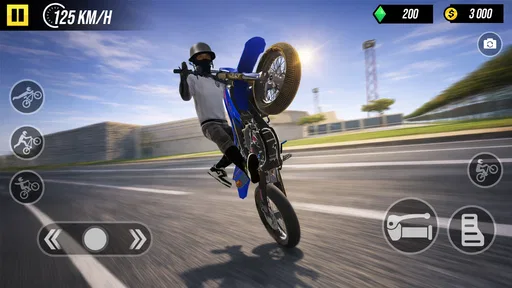
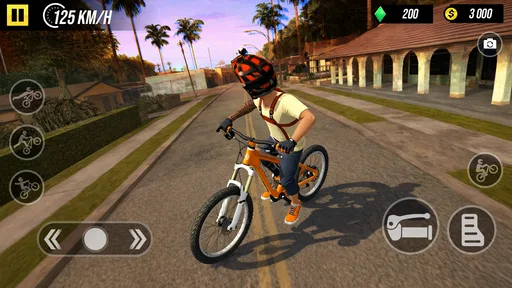

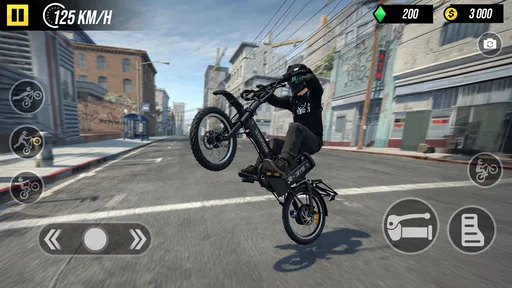

Our Review of Wheelie Life: Moto Stunt
 Analysis by Appyee
I approached Wheelie Life: Moto Stunt as a quick racing game rather than a full motorcycle simulator, and that distinction matters. Its appeal is immediate: get moving, keep the front wheel raised, and judge traffic and road space before a mistake ends the run. The concept is easy to understand, but staying in control takes more patience than the simple premise suggests. I found myself replaying short attempts not because the game buried me in menus, but because each failed wheelie made me want to correct one small part of my timing.
This is a free racing game from iJ Sound, rated for Everyone, with a 4.7 average from around 3.3 thousand ratings and over 1 million installs. It runs on Android 8.0 or later, and version 3.9 is the current release. Those details make it an accessible choice for someone who wants a lightweight motorcycle challenge, especially if the idea of stunt riding through a city sounds more attractive than traditional lap racing.
What to judge before choosing this kind of racing game
The first question is not whether you like motorcycles. It is whether you enjoy a game built around balance and correction. In a conventional racing title, the main goal is usually to brake at the right point, take a clean corner, and maintain speed around a course. Here, the satisfying moment comes from holding a wheelie long enough to feel deliberate without letting the bike tip too far. That creates a different rhythm: acceleration, lift, adjustment, recovery, and another attempt.
I also considered how well the game works in ordinary spare-time situations. A title like this needs to be understandable without a long tutorial session. If I have a few minutes while waiting for an appointment, I want to start riding quickly, make a few attempts, and stop without feeling that I abandoned a complicated campaign. Wheelie Life: Moto Stunt suits that habit better than games that depend on long races, extensive vehicle setup, or a large progression map.
Control comfort is another important decision point. Stunt riding asks for small, repeated inputs, so the experience depends on whether the controls feel manageable on your particular phone. A large screen may make the action easier to read, while a smaller display can make traffic and balance changes feel more crowded. I would not choose this game expecting the same precision as a dedicated controller-based racer. Its strength is quick mobile interaction, not a serious simulation setup.
Finally, I would decide whether I want a focused challenge or a broad package. The store summary centers on racing, wheelies, flips, and city traffic. That tells me the core attraction is the stunt itself, not a deep collection of unrelated activities. For me, that focus is useful when I want a game with a clear identity. It may feel narrow if I expect a large garage, detailed tuning, structured championships, or a story-driven career.
The first rides: simple rules, demanding timing
The basic objective is easy to grasp. I ride through an urban setting, raise the front wheel, and try to keep the motorcycle stable while dealing with the road ahead. The challenge is that a wheelie is not a single action. Lifting the front wheel is only the beginning; the real work is making small corrections before the bike reaches an unrecoverable angle or the surrounding traffic leaves too little room.
That gives the game a useful learning curve without requiring complicated racing knowledge. A new player can understand the goal immediately, but improvement comes from observing what happened in the previous attempt. Did I accelerate too aggressively? Did I react late when the bike began to lean? Did I focus so much on the stunt that I ignored what was ahead? These questions turn short runs into practical lessons.
The best way to play is to treat every attempt as a timing exercise, not a speed test. I had better results when I built a stable rhythm first and only then tried to extend the stunt. Chasing a spectacular distance too early usually created a messy correction, especially when traffic demanded attention. That approach is more satisfying than simply holding a control and hoping the game carries the run for me.
Why the city setting changes the challenge
City traffic gives the riding space a second layer of pressure. A clear road lets me concentrate on balance, but an occupied road forces a choice between preserving the wheelie and protecting the run. That trade-off is where the game becomes more interesting than a practice area with no obstacles. I have to decide whether to lower the front wheel, adjust my line, or accept that the stunt is no longer worth saving.
This also creates a practical tip for beginners: do not stare only at the motorcycle. Watch the road far enough ahead to leave yourself time to react. Looking at the front wheel may feel natural when learning balance, but it reduces the time available to handle traffic. I found that checking the route first and using peripheral attention for the bike produced calmer decisions.
Traffic also makes the game suitable for short repeat sessions. A run can change because the road situation demands a different response, even when the basic objective remains the same. That keeps the central mechanic from feeling completely automatic. Still, players who dislike repeating similar attempts may eventually find the focused structure limiting.
Small techniques that make a noticeable difference
My first useful adjustment was separating launch control from maintenance control. The input that gets the front wheel up is not necessarily the input I should keep using at the same intensity. Once the motorcycle reaches a comfortable angle, gentler corrections are more reliable than continuing with the same force. This sounds obvious, but it is easy to forget when the action becomes exciting.
A second technique is to lower the ambition when the road becomes crowded. A shorter, controlled wheelie that survives traffic is more valuable than a dramatic attempt that ends immediately. This is especially useful for players who are trying to improve consistency rather than chase one impressive run. The game rewards restraint as much as boldness, at least in the way I experienced its central challenge.
I also recommend using a repeatable routine when practicing: begin with a modest lift, watch how quickly the bike responds, and make one correction at a time. Changing several things at once makes it difficult to understand why an attempt failed. By keeping the process simple, I could tell whether my problem was acceleration, balance, or road awareness.
One less obvious trade-off is that playing aggressively can be less educational than playing conservatively. A spectacular crash may be memorable, but a controlled recovery teaches more about the handling. If you want to improve, deliberately end a few attempts by lowering the front wheel before the bike becomes unstable. That gives you information about the safe limit instead of only showing the point beyond it.
Where this game wins, and where another style may fit better
The strongest part of Wheelie Life: Moto Stunt is its clear focus. I do not need to learn a complicated career structure before reaching the feature that makes the game distinctive. The combination of motorcycle balance and city movement gives it an identity that ordinary traffic racers do not always have. It is also more immediately approachable than a simulation that expects careful tuning, realistic braking habits, or long races.
That focus makes it a good match for players who enjoy mastery through repetition. If you like trying the same kind of maneuver with slightly better timing each time, the game has a natural hook. It can also work well for someone who wants to show a friend the basic idea quickly: the objective is visible on the screen, and the result of a successful or failed attempt is easy to understand.
The free price lowers the barrier to trying it. I can install a racing game like this without first deciding whether a paid purchase is justified, which is helpful when I am unsure whether stunt-focused riding will hold my attention. The Everyone age rating also makes it a broadly approachable choice for casual play, although younger players may still need help with the repeated trial-and-error nature of the challenge.
Where it may lose ground is breadth. Players choosing a traditional racing game for championship structure, varied track types, extensive vehicle collections, or a more formal sense of progression may prefer a different category of title. I would also look elsewhere if my priority were realistic motorcycle physics rather than an accessible stunt experience. This game asks me to enjoy the feel of balancing and navigating, not to treat every behavior as a detailed real-world simulation.
Arcade racers are a better fit when you want immediate speed, forgiving handling, and races that focus on overtaking rather than maintaining a wheelie. Traffic-focused driving games may suit you more if weaving through vehicles is the main attraction and the stunt element feels like a distraction. Simulation-oriented motorcycle games are preferable when you want technical setup and realism. Wheelie Life: Moto Stunt sits between these choices: more specialized than a basic arcade racer, but less demanding and less comprehensive than a simulation.
That comparison also explains who should skip it. I would not recommend it to someone who becomes frustrated by repeating short attempts, or to a player who wants a large variety of objectives from the first session. It is not the right pick if the main pleasure comes from customizing a machine, competing through a structured season, or learning realistic track technique. The game is most convincing when its narrow idea is exactly what you want.
Everyday use: a good five-minute game, with one condition
Imagine waiting for a bus with only a few minutes available. I can open the game, begin a run, practice a controlled lift, and stop after a handful of attempts. There is no need to remember a complicated mission or preserve a long session of progress in my head. That makes it a practical companion for brief breaks, especially when I want active concentration rather than a passive distraction.
The condition is that the game may demand more focus than its short-session format suggests. Traffic and balance do not combine well with constant interruptions. If I am checking messages every few seconds, I am likely to miss a correction or react too late to the road. For a truly distracted moment, a slower puzzle or idle game would be more forgiving. This is a quick game, but it is not always a low-attention game.
On a longer evening session, the experience depends heavily on whether I enjoy self-directed improvement. Without a broader objective to pull me forward, I need to create my own goals: hold the wheelie longer, recover from a difficult angle, pass a crowded section cleanly, or finish a run without sacrificing control for spectacle. That can feel rewarding to an arcade-minded player, but empty to someone who expects constant unlocks and new systems.
What switching to another racing game would really change
Moving to a conventional racing game would probably give me more variety in how I compete. I might trade the concentrated balance challenge for laps, overtaking, cornering, or vehicle progression. That switch makes sense if I have exhausted the pleasure of refining wheelies or want a stronger sense of structured advancement.
Moving to a simulator would change the relationship with the motorcycle even more. I would likely spend more time managing realistic technique and setup, and less time repeating a single stunt through traffic. That can be a better use of time for a rider who values authenticity, but it also introduces more complexity. Wheelie Life: Moto Stunt is easier to pick up because it puts the stunt at the center instead of asking me to master an entire riding discipline.
The cost of switching is therefore not only storage space or learning controls. It is also giving up the particular satisfaction of a clean recovery after a near-mistake. If that moment is what keeps you playing, another racing category may feel less engaging even if it offers more content. On the other hand, if you need variety to stay interested, changing games sooner may be the sensible choice rather than expecting this focused experience to become something else.
Installation, compatibility, and who gets the most from it
The game is free and supports Android 8.0 or later, so it is positioned for a wide range of compatible Android devices. I would still consider screen size and touch comfort before committing to long sessions. A game built around small balance corrections benefits from a display where the road and motorcycle remain easy to read, and from controls that do not feel cramped under your hands.
With version 3.9 in use, I would approach it as a straightforward pick-up-and-play racing game rather than a purchase decision requiring a large commitment. Its popularity is reflected in over 1 million installs, while the 4.7 average from around 3.3 thousand ratings suggests that the focused stunt idea connects strongly with many players. I treat those figures as useful context, not a substitute for matching the game to my own taste.
My recommendation is clear: try it if you want a free motorcycle game built around wheelie control, city traffic, and repeated improvement. Start conservatively, look ahead instead of fixating on the front wheel, and use short practice goals rather than demanding a perfect run immediately. Those habits reveal the game at its best.
I would choose another racing title if I wanted realistic simulation, extensive customization, formal championships, or a wide selection of racing formats. For everyone else, especially players who enjoy compact challenges with a distinctive central mechanic, Wheelie Life: Moto Stunt is an easy game to recommend with realistic expectations. It does not need to be a complete motorcycle world to work; its value comes from making one stunt feel difficult, readable, and worth trying again.
Privacy and Permissions
See what permissions an app requests and how it handles your data.
- Wi-Fi connection information
- view Wi-Fi connections
- Other
- view network connections, full network access, control vibration, prevent device from sleeping, Google Play license check
Verdict
Strengths of Wheelie Life: Moto Stunt
- Responsive controls make wheelies and balance tricks easy to learn.
- Several bikes offer different handling styles and visual customization options.
- Open environments provide room to practice stunts without strict time limits.
- Short sessions work well for quick gameplay on mobile devices.
- Simple graphics help the game run smoothly on many mid-range phones.
Limitations of Wheelie Life: Moto Stunt
- Physics can feel inconsistent when landing or colliding with obstacles.
- The gameplay may become repetitive after mastering the main stunt mechanics.
- Ads can interrupt play and reduce the overall flow of sessions.
- Advanced bikes or customization options may require significant grinding.
- Limited challenge variety may disappoint players seeking deeper progression.
Similar Picks in This Category
View All
Hill Climb Racing
Fingersoft4.3

Dr. Driving
SUD Inc.4.2

Traffic Rider
skgames4.5

Asphalt 8 - Car Racing Game
Gameloft SE4.6

Race Master 3D: Car Racing
Beresnev Games4.6

Extreme Car Driving Simulator
AxesInMotion Racing4.3
Frequently Asked Questions
What is Wheelie Life: Moto Stunt, and how is the gameplay structured?
Wheelie Life: Moto Stunt is a motorcycle stunt game focused on maintaining long wheelies while riding through obstacle-filled environments. After installing it, players can practice balance, control speed, and attempt longer or more stylish stunts. The gameplay is easy to understand, but keeping the front wheel raised becomes increasingly difficult as the track introduces ramps, uneven surfaces, and tighter spaces.
Is Wheelie Life: Moto Stunt suitable for beginners?
Yes, the game is generally accessible to beginners because its main objective is simple and the controls are easy to learn. However, mastering the motorcycle requires patience. New players may frequently lose balance or crash while learning how acceleration and braking affect the wheelie. A short practice period is recommended before attempting difficult tracks or aiming for high scores.
Does Wheelie Life: Moto Stunt require an internet connection to play?
Wheelie Life: Moto Stunt is primarily designed as a casual stunt experience, so many of its core riding activities can usually be enjoyed without a constant internet connection. Offline availability may depend on the specific version and device, especially for advertisements, updates, or optional online features. It is best to launch the game once while connected before playing completely offline.
Are there different motorcycles, customization options, or progression features?
The game may offer more than one motorcycle or progression-based content, depending on the version available on your device. These features can give players additional goals beyond simply completing a wheelie. Before downloading, users should check the current store listing for the exact selection of bikes, customization choices, unlockable content, and whether any items require in-app purchases.
Are there advertisements or in-app purchases in Wheelie Life: Moto Stunt?
As with many free-to-download mobile games, Wheelie Life: Moto Stunt may include advertisements, particularly between attempts or while navigating menus. The frequency can vary by device, region, and game version. Some editions may also provide optional purchases for removing ads or unlocking content. Review the Google Play or App Store payment information before downloading if you prefer an uninterrupted experience.
Play our best games!


